

Your Factory Has a Reaction Time. How Fast Is It?
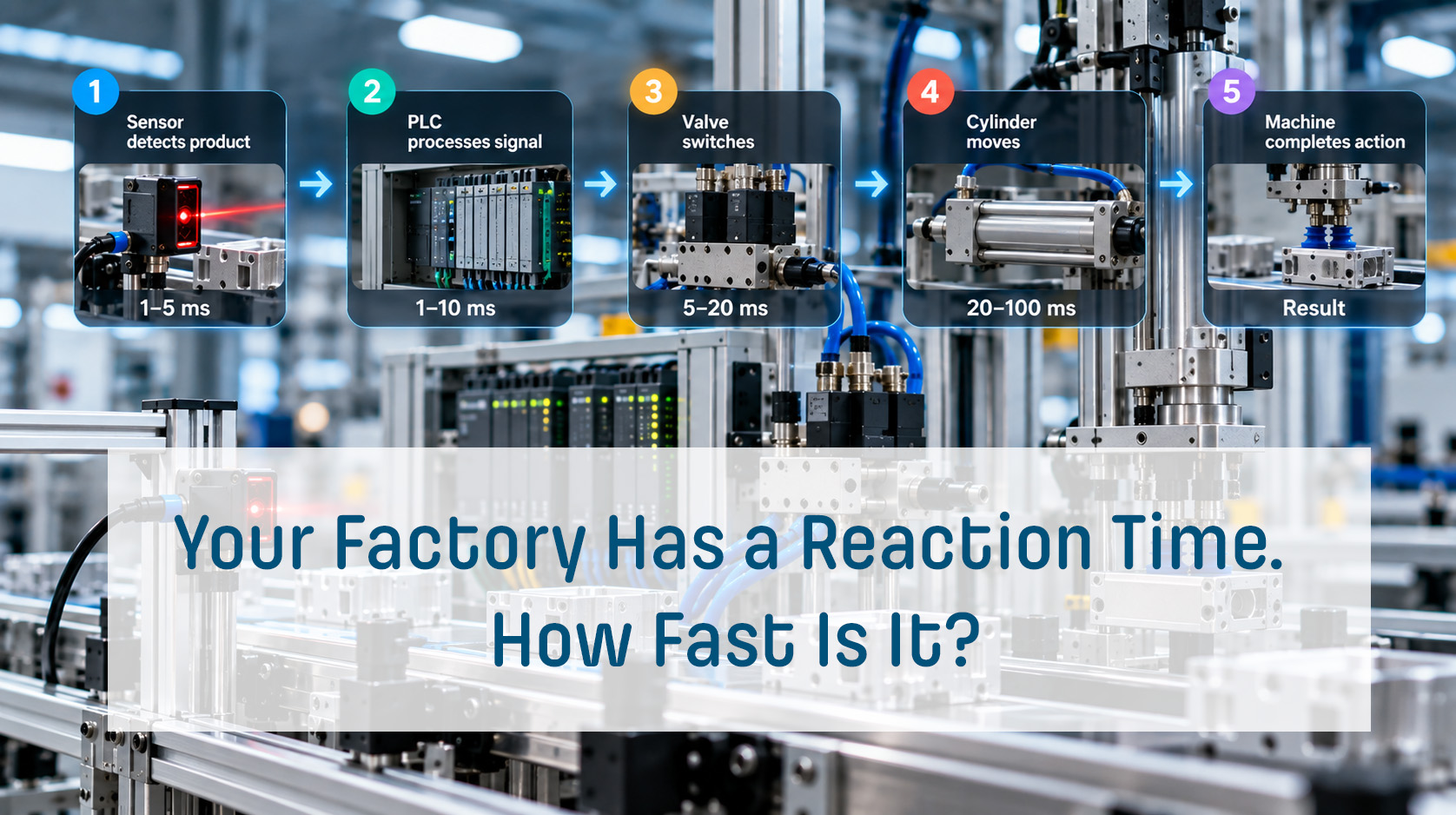
A product arrives at a station. A sensor detects it. The controller makes a decision. A valve switches. A pneumatic cylinder moves. The next operation begins.
To an operator watching the production line, all of this may appear to happen instantly.
But behind every automated movement is a sequence of reactions taking place in milliseconds. When thousands of cycles are repeated every day, even small delays within that sequence can influence machine speed, consistency and overall production output.
So, how quickly does your production line actually react?
It Starts with Detection
Before a machine can respond, it first needs to know that something has happened.
Industrial sensors detect conditions such as:
- Product presence
- Position
- Pressure
- Temperature
- Distance
- Flow
Once the required condition is detected, the sensor sends a signal to the machine’s control system.
Sensor selection matters here. Response speed, sensing distance, environmental conditions and the type of object being detected can all influence how reliably the process begins.
The PLC Makes the Decision
Next, the PLC receives the sensor signal and determines what should happen.
It might instruct the machine to:
- Extend a cylinder
- Activate a clamp
- Open or close a valve
- Reject a defective product
- Trigger an inspection
- Stop the machine
The PLC processes its programmed logic and sends the appropriate output signal.
For a simple operation, this happens extremely quickly. But as automation becomes more sophisticated, multiple sensors, safety conditions and machine states may need to be evaluated before the next action is allowed.
The Valve Turns a Signal into Action
In a pneumatic system, an electrical signal alone cannot move the cylinder.
The PLC activates a solenoid valve, which changes the direction of compressed air within the pneumatic circuit.
The valve therefore becomes an important link between the machine’s digital control system and its physical movement.
Valve response, airflow capacity, tubing configuration and available pressure can all affect how quickly the actuator responds.
Then the Cylinder Has to Move
Once compressed air reaches the actuator, the cylinder begins its stroke.
Its actual movement depends on several factors, including:
- Cylinder size
- Stroke length
- Load
- Air pressure
- Available airflow
- Flow control settings
- Tubing size and length
This is why simply installing a faster PLC or sensor does not necessarily create a faster machine.
The entire chain needs to work together.
Milliseconds Add Up
Imagine an automated line performing the same operation thousands of times per shift.
A small delay in one component may seem insignificant during a single cycle. Repeated continuously, however, unnecessary delays can contribute to longer cycle times and lower overall throughput.
More importantly, inconsistent response can create problems with timing.
A cylinder arriving slightly late could affect clamping. A sensor detecting a product inconsistently could disrupt sequencing. A delayed inspection result could affect the rejection mechanism further down the line.
Optimising automation therefore isn’t always about making individual components move faster. It is about ensuring the whole sequence responds consistently and at the right time.
Seeing the Production Line as a Complete System
A high-performing automated production line depends on more than one fast component.
Sensors need to detect reliably. Controllers need to process signals correctly. Valves need to respond consistently. Pneumatic systems need sufficient pressure and flow. Actuators need to complete their movements within the required cycle time.
Machine vision and identification systems may also need to inspect, verify or read a product before the next operation can begin.
When these technologies are properly integrated, the result is an automation system that feels almost instantaneous.
How Fast Does Your Factory Need to Be?
The goal isn’t necessarily to achieve the fastest possible reaction time.
For some applications, speed is critical. For others, positioning accuracy, safety, repeatability or product quality matters more.
The real objective is to ensure that every component responds quickly enough, consistently enough and reliably enough for the application.
Understanding where time is being spent within an automation sequence can help engineers identify bottlenecks and make better decisions when selecting sensors, valves, pneumatic components and control equipment.
Conclusion
Every automated factory has a reaction time.
Between detecting a product and creating physical movement, sensors, controllers, valves and actuators perform a carefully coordinated sequence in a fraction of a second.
When production demands increase, those fractions of a second can matter.
Understanding how each part of the automation chain responds can help manufacturers improve cycle consistency, identify hidden bottlenecks and build production systems that are not simply faster, but more reliable.
Want to improve the response and reliability of your automation system? Speak with our automation specialists to find the right components for your application.

