

What Happens in Just One Second on an Automated Production Line?
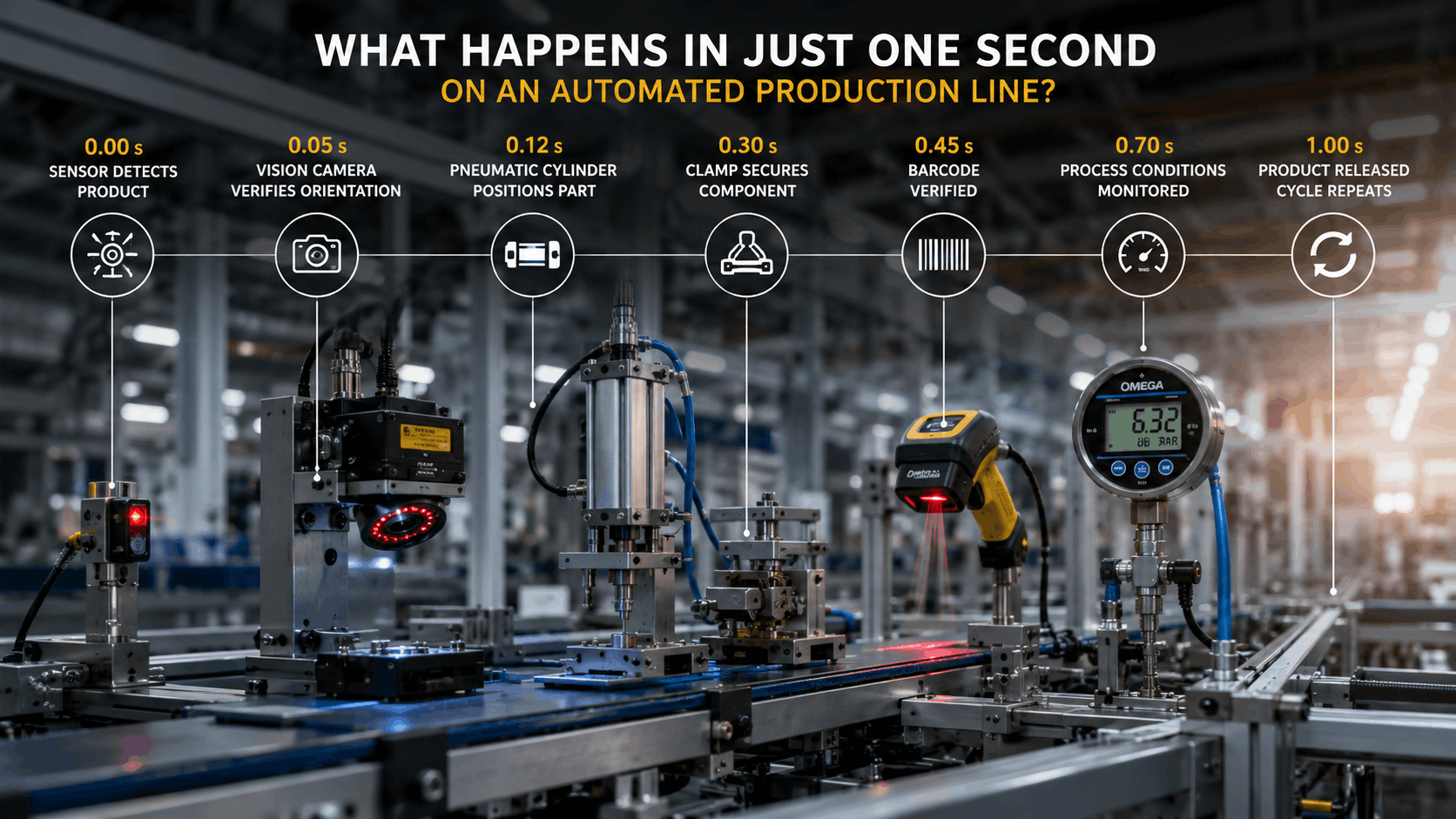
When we think about factory automation, we often picture robots, conveyor belts, and machines working at incredible speeds. What we don’t see is the remarkable amount of coordination happening behind the scenes.
In just one second, dozens of automated actions can take place to ensure every product is correctly positioned, inspected, assembled, and ready for the next stage.
Let’s take a closer look at what happens during a typical production cycle.
0.00 Seconds: A Sensor Detects the Product
The process begins the moment a product arrives at the workstation.
Photoelectric or proximity sensors instantly detect the presence of the product and send a signal to the control system. This tells the machine exactly when to begin the next sequence.
Without reliable sensors, the entire production cycle could be mistimed, resulting in jams or missed operations.
0.05 Seconds: Machine Vision Confirms Everything Is Correct
Before any operation begins, a machine vision system verifies that the product is in the correct position and orientation.
Using intelligent vision systems such as those from Cognex, manufacturers can:
- Verify part orientation
- Detect missing components
- Inspect product quality
- Read barcodes or QR codes
This ensures only correctly positioned products continue through the production line.
0.12 Seconds: Pneumatic Actuators Get to Work
Once inspection is complete, pneumatic cylinders move into action.
Depending on the application, they may:
- Position the product
- Push it into place
- Transfer it between stations
- Activate a tooling mechanism
Pneumatic automation remains one of the fastest and most reliable methods for repetitive industrial motion, making it ideal for high-speed manufacturing.
0.30 Seconds: Precision Clamping Secures the Product
Before machining, assembly, or testing begins, the product must be held securely.
Pneumatic clamping systems provide consistent holding force while allowing rapid cycle times.
Reliable clamping ensures every operation is performed with the same level of accuracy, helping reduce defects and improve repeatability.
0.45 Seconds: Product Identity Is Verified
As the process continues, barcode readers verify product information.
Modern vision systems can read:
- 1D barcodes
- 2D Data Matrix codes
- QR codes
- Serial numbers
This enables complete product traceability and ensures the correct product moves to the next stage of production.
0.70 Seconds: Process Conditions Are Continuously Monitored
While the machine is operating, instrumentation is constantly checking critical process conditions.
Pressure sensors, temperature sensors, and differential pressure instruments monitor whether equipment is operating within the required limits.
Solutions from Omega Engineering and Dwyer Instruments help manufacturers maintain stable operating conditions while providing early warning of potential issues before they lead to downtime.
1.00 Second: The Cycle Begins Again
The finished product moves to the next station, and the next production cycle starts immediately.
This sequence repeats hundreds or even thousands of times every hour.
Behind every second of production is a carefully coordinated combination of sensors, machine vision, pneumatic automation, instrumentation, and motion control, all working together to deliver consistent quality and efficient manufacturing.
Every Second Matters
Although each operation takes only fractions of a second, every movement must be precise. A delayed sensor, inaccurate measurement, weak pneumatic actuator, or missed inspection can disrupt the entire production line.
That is why manufacturers invest in reliable automation technologies that work together seamlessly to maximise uptime, improve quality, and maintain production efficiency.
Whether it’s intelligent machine vision from Cognex, precision instrumentation from Omega Engineering and Dwyer Instruments, or dependable pneumatic automation solutions, every component plays a vital role in keeping production lines moving.
Contact our automation specialists to discover how the right automation solutions can help improve speed, accuracy, and reliability across your production line.

