

Pneumatic vs Electric Actuators: Which Automation Solution is Right for Your Application?
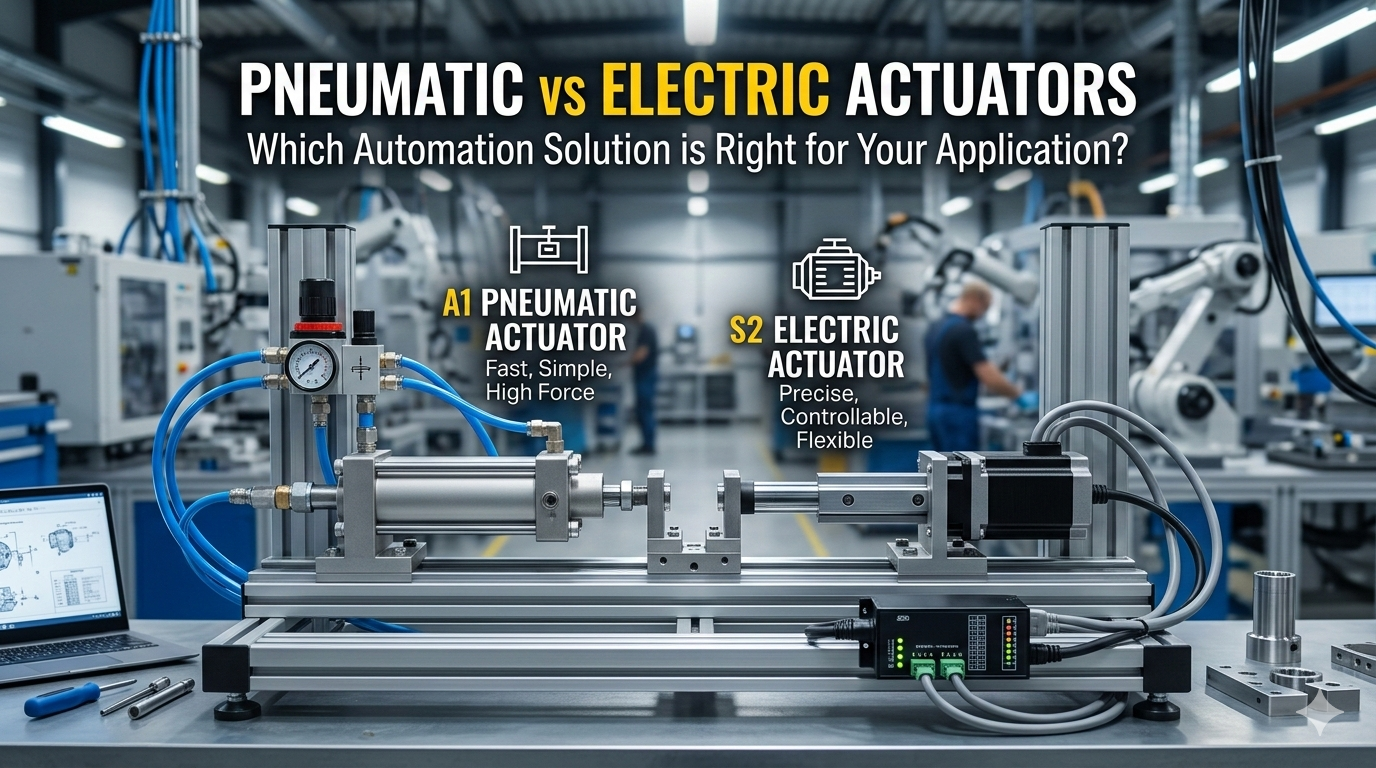
Automation systems rely heavily on actuators to convert energy into mechanical motion. Two of the most widely used technologies in industrial automation are pneumatic actuators and electric actuators. While both serve the same purpose – producing motion to perform tasks – they differ significantly in terms of operation, performance, cost, and application suitability.
Understanding the differences between these two technologies is essential for engineers, system integrators, and manufacturers looking to select the most efficient solution for their automation needs.
This article explores the key differences between pneumatic and electric actuators, their advantages, and how to determine which option is best suited for your application.
What is a Pneumatic Actuator?
A pneumatic actuator uses compressed air to generate mechanical motion. When pressurized air enters the actuator, it pushes a piston or diaphragm that produces linear or rotary movement.
Common pneumatic components include:
- Pneumatic cylinders
- Directional control valves
- Air preparation units (FRL – filter, regulator, lubricator)
- Flow control valves
- Air compressors
Pneumatic actuators are widely used in industries such as packaging, automotive manufacturing, food processing, and electronics assembly due to their speed, simplicity, and durability.
What is an Electric Actuator?
An electric actuator uses an electric motor combined with a mechanical transmission system, such as a lead screw or ball screw, to generate movement.
Electric actuators are typically controlled by:
- Servo motors
- Stepper motors
- Motor drivers
- Controllers or PLC systems
Because electric actuators allow precise positioning and programmable control, they are often used in applications that require accurate motion control and repeatability.
Key Differences Between Pneumatic and Electric Actuators
1. Speed and Cycle Time
Pneumatic actuators are known for their fast response and high-speed operation. Since compressed air moves rapidly through the system, pneumatic cylinders can achieve quick extension and retraction.
This makes pneumatics ideal for:
- Pick-and-place operations
- High-speed packaging lines
- Sorting and material handling
Electric actuators, while capable of high speeds, are generally optimized for controlled motion rather than rapid cycling.
Winner for speed: Pneumatic actuators
2. Precision and Position Control
Electric actuators provide excellent positioning accuracy and repeatability. With servo or stepper motor control, they can move to specific positions with high precision.
Pneumatic actuators typically operate in end-of-stroke motion (fully extended or fully retracted), making them less suitable for applications requiring precise positioning.
However, with additional sensors and control valves, limited positioning control can still be achieved.
Winner for precision: Electric actuators
3. Force Capability
Both actuator types can generate significant force, but they achieve this differently.
Pneumatic actuators generate force based on air pressure and piston area, making them suitable for many industrial tasks.
Electric actuators generate force through motor torque and mechanical transmission, allowing controlled force output.
For extremely high force applications, hydraulic systems are often used instead.
Winner: Application dependent
4. Cost and Installation
Pneumatic systems generally have lower initial equipment costs. Pneumatic cylinders and valves are relatively inexpensive and easy to install.
However, they require supporting infrastructure such as:
- Air compressors
- Air dryers
- Air piping systems
Electric actuators may have higher upfront costs, but they do not require compressed air infrastructure.
In facilities that already have compressed air systems, pneumatic actuators often remain the most cost-effective solution.
Winner: Pneumatic actuators (in many industrial environments)
5. Maintenance and Reliability
Pneumatic systems are known for their simple design and robust operation. Many components have fewer moving parts, making them highly reliable in harsh environments.
Electric actuators contain motors, electronics, and control circuits that may require more careful handling and maintenance.
However, modern electric actuators are becoming increasingly reliable due to advances in motor technology and control systems.
Winner: Pneumatic actuators for harsh environments
6. Energy Efficiency
Electric actuators are typically more energy efficient, as they convert electrical energy directly into motion.
Pneumatic systems can lose energy through:
- Air leaks
- Pressure losses
- Compressor inefficiencies
For applications that require continuous operation and precise motion control, electric actuators may provide better long-term energy efficiency.
Winner: Electric actuators
When to Choose Pneumatic Actuators
Pneumatic actuators are often the best choice when:
- High speed operation is required
- Motion is simple (extend/retract)
- The environment is harsh or dusty
- Initial cost must be minimized
- Existing compressed air systems are available
Typical applications include:
- Packaging machinery
- Assembly automation
- Material handling
- Clamping systems
- Conveyor diverters
When to Choose Electric Actuators
Electric actuators are better suited for applications where:
- Precise positioning is required
- Programmable motion profiles are needed
- Energy efficiency is a priority
- Variable speed control is important
Typical applications include:
- Robotics
- CNC machinery
- Medical equipment
- Semiconductor manufacturing
- Precision assembly systems
Combining Pneumatic and Electric Automation
In many modern factories, the most effective automation systems combine both pneumatic and electric technologies.
For example:
- Pneumatics for high-speed repetitive tasks
- Electric actuators for precision positioning
By integrating the strengths of both systems, manufacturers can achieve optimal performance, efficiency, and flexibility.
Conclusion
Both pneumatic and electric actuators play critical roles in industrial automation. The right choice depends on factors such as speed, precision, cost, environment, and system requirements.
Pneumatic actuators continue to dominate applications that require speed, simplicity, and reliability, while electric actuators excel in precision and programmable motion control.
By carefully evaluating your operational needs, engineers can select the most suitable actuator technology to maximize productivity and efficiency in their automation systems.

